
About this Guide
From 1 November 2026, any application lodged with the Commission for renewable energy developments under Section 37E of the Planning and Development Act, 2000 are subject to mandatory EIA scoping.The following information provides a Guide for the Commission, which can be used by prospective applicants, prescribed bodies and other participants, in respect of EIA Scoping as it relates to Strategic Infrastructure Renewable Energy Developments submitted directly to An Coimisiún Pleanála. This is a Guide only and does not comprise Guidelines on EIA Scoping. The Guide has been prepared in association with ERM. The Guide is primarily focused on onshore wind energy developments but much of the contents will be applicable to other Strategic Infrastructure Renewable Energy Developments.These guidelines and associated appendices are available in a printable version at the end of the page. The Guide will be updated as required.
This guide is set out under the headings:
- 1. Introduction
- 2. Key Procedural Considerations
- 3. What is EIA Scoping?
- 4. Legislative Requirements
- 5. The Scoping Report
- 6. Consultation with Prescribed Bodies
- 7. Likely Significant Effects
- 8. Baselines for Environmental Assessment
- 9. Consideration of Environmental Factors
- 10. The Scoping Opinion
- 11. Format of the EIAR
- 12. Appendices

1. Introduction
The RED III Directive has been transposed into Irish legislation by way of European Union (Planning and Development) (Renewable Energy) Regulations 2025 (S.I. 274 of 2025). European Union (Planning and Development) (Renewable Energy) (No. 3) Regulations 2025 (S.I. 435 of 2025) amends the original Regulation to postpone the coming into effect of mandatory EIA Scoping from 1 October 2025 (S.I. 274 of 2025) to 1 May 2026 (S.I. 435 of 2025). A further amending Regulation, European Union (Planning and Development) (Renewable Energy) (Amendment) Regulations 2026 (S.I. 185 of 2026) postpone the coming into effect of mandatory Scoping from 1 May 2026 to 1 November 2026.
The provisions of the Regulations apply to onshore and offshore renewable energy development.
The Regulations define renewable energy as:
Renewable energy developments which are administered by An Coimisiún Pleanála are those listed in the Seventh Schedule of the Planning and Development Act 2000, as amended, which comply with the definition of renewable energy as outlined in the definition and alterations to same.
As per Circular CEPP 1/2026, dated 9 January 2026, it is a matter for the planning authority to identify those developments that comprise RED III projects. This will be undertaken at the pre-application consultation stage under Section 37B or Section 287 of the Planning and Development Act 2000, as amended.
Any applications submitted directly to An Coimisiún Pleanála under Section 37E must be accompanied by an EIAR (Section 37E(1)). Marine renewable energy developments submitted under Section 293 are not required to be accompanied by an EIAR, however most such projects will exceed the threshold set out in the Fifth Schedule of the Planning and Development Regulations, 2001, as amended such that the submission of an EIAR would be mandatory.
European Union (Planning and Development) (Renewable Energy) Regulations 2026 (S.I. 323 of 2025) came into effect on 9 July 2026 and amend Section 37B and Section 37D of the Planning and Development Act 2000, as amended to facilitate paralleling of the Pre-Application Consultation and EIA Scoping Processes. This applies only to Renewable energy projects
This Guide provides the legislative requirements for all EIA scoping requests with the details outlined in Sections 8, 9 and 10 focused on onshore wind energy development given the prevalence of those case types received by the Commission but much of the content is relevant for all SID developments. The Guide will be updated to include other relevant development types.
2. Key Procedural Considerations
Where to Submit
A request to scope an EIAR should be made in writing to: An Coimisiún Pleanála, 64 Marlborough Street, Dublin 1.
When to Submit
Following the coming into effect of S.I 323 of 2026 on 9 July 2026, the Scoping Request can be submitted once a pre-application request has been made under Section 37B of the Planning and Development Act 2000, as amended (for renewable energy developments). The considerations in respect of the most appropriate time to submit the Scoping Request should be discussed at the first Pre-Application Meeting
with the Commission.
What to Submit
The prospective applicant must supply the Commission with sufficient information in relation to the proposed development to enable prescribed bodies to make informed submissions and for the Commission to give an opinion in relation to the request. In particular, the proposed development must be adequately detailed and described and clearly indicated on drawings of an appropriate scale.
The prospective applicant is also required to submit a Scoping Report and this is described in more detail in Section 5 below.
The Commission may request the prospective applicant to submit sufficient hard or electronic copies of the scoping request so that it can be circulated to the appropriate prescribed bodies. It is suggested that one hard copy and one soft copy be submitted to the Commission.
Timeline for Opinion
There is no statutory time period provided for in the legislation for the Commission to make an opinion on a scoping request. The Commission is required to comply with a request for scoping as soon as is practicable.
Fees
In accordance with the provisions of section 144 of the Planning and Development Act 2000, as amended, the Commission has determined that a fee shall be charged for any scoping request received on or after 5th September 2011 for a written opinion on the information to be contained in an Environmental Impact Assessment Report. Please refer to the Commission’s "Guide to Fees payable to An Comisiún Pleanála" for information on current fees. In this regard the fee for the scoping request is €5,000.
Scoping Opinion
The scoping opinion provided by the Commission will be sent to the prospective applicant together with any submissions submitted by prescribed bodies.
The Commission’s file on the scoping procedure will be available for public inspection at the Commission’s offices following the Determination of the Pre-Application Consultation Process.
The case will be listed on the Commission’s weekly list of cases determined and the opinion will be posted on the Commission’s website.
The Scoping Opinion must accompany the application.
Changes Post Scoping
Applicants should also be aware that where a proposed development changes materially from that presented in the scoping request and upon which the Scoping Opinion relates, such that different or additional likely significant effects may arise, it may no longer be appropriate to rely on the existing Scoping Opinion.
In such circumstances, and where changes go beyond the design parameters considered at scoping stage, it may be necessary to re‑engage in scoping, in consultation with An Coimisiún Pleanála, to ensure that the scope of environmental assessment remains appropriate to the revised proposal. You are advised to contact the Commission should this arise.
Public Participation
As there is no decision or determination made by the Commission on the merits of the proposed development, there is no provision for public participation at this stage of the process, therefore submissions from the public will not be invited or accepted.
3. What is EIA Scoping?
The European Commissions, Environmental Impact Assessment, Guidance on Scoping, 2017 defines scoping as “the process of identifying the content and extent of the information to be submitted to the Competent Authority under the EIA process”.
The document also states that it “should define the EIA Report’s Terms of Reference and the level of detail of the information necessary for the assessment as well as giving an indication, as well as providing an estimate of the time needed to prepare the EIA Report, and its possible length”.
The document sets out the benefits of Scoping in EIA, relevant elements of which are set out as follows:
- Identifies key issues to be addressed: Scoping helps to ensure that the environmental information used for decision-making provides a comprehensive picture of the Project’s important effects, including issues of particular concern to the groups and individuals affected.
- Saves time and money: Scoping helps focus resources on the important issues for decision-making and avoids wasted effort on issues of little relevance. In addition, it reduces the risk of delays caused by requests for further information after the submission of the Development Consent application and the provision of environmental information.
- Sets appropriate time and space boundaries: Scoping aids in effective planning, management, and with resourcing of the EIA Report. It can identify other legislation or regulatory controls that may be relevant to the Project and can provide opportunities for the necessary assessment work, for different control systems, to be undertaken in parallel, thereby avoiding the duplication of effort and costs for all concerned.
- Helps to identify preliminary Alternatives and Mitigation Measures: Scoping should identify preliminary Alternatives to the proposed Project as well as preliminary mitigating measures that ought to be considered by the Developer.
The EPA’s Guidelines on the Information to be contained in EIAR’s (2022) address scoping in Section 3.3. It is stated at section 3.3.1 that “the provision of sufficient detail at the scoping stage is the best way to facilitate useful and specific responses from consultees”.
Of particular note are the key scoping criteria set out in Section 3.3.4 as follows:
All parties should be aware of the need to keep the EIAR as tightly focused as possible. This focuses the effort and resources of all parties on the key significant issues. Scoping is usually guided by the following criteria (bold is ACP emphasis):-
- Use ‘Likely’ and ‘Significant’ as the principal criteria for determining what should be addressed. Any issues that do not pass this test should be omitted (scoped out) from further assessment. A section of the EIAR should describe the scoping process explaining why such issues have been scoped out and they are not being considered further. All the prescribed environmental factors (Art3(1) of 2014/52/EU) need to be listed in the scoping section of the EIAR. It is important to note that the environmental factors themselves cannot be scoped out and must feature in the EIAR. Only subtopics and headings related to each factor can be scoped in or out. Each environmental factor should be clearly covered by one or more specific section headings in the EIAR. If scoping determines that no likely significant issues arise under any heading, then an explanatory text should be included.
- Precedence - where EIARs for similar projects on similar sites or for other project proposals for the same site are available, these can be useful references.
- Interactions – careful consideration of pathways – direct and indirect – that can magnify effects through the interaction or accumulation of effects – for instance the potential for cumulative significant effects to arise from multiple non-significant effects. (See also Indirect, Secondary and/or Cumulative Impacts in section 3.7.3).
4. Legislative Requirements
The following sections provide an overview of the main legislative considerations. It should be noted that it is provided for context and is not proposed as a comprehensive review. All participants in the scoping process should satisfy themselves that they understand the legal requirements pertaining to the relevant proposed development.
4.1 EIA Directive
Art 5(1) of 2014/52/EU sets out that:
Where an environmental impact assessment is required, the developer shall prepare and submit an environmental impact assessment report. The information to be provided by the developer shall include at least:
- A. A description of the project comprising information on the site, design, size and other relevant features of the project.
- B. A description of the likely significant effects of the project on the environment.
- C. A description of the features of the project and/or measures envisaged in order to avoid, present or reduce and, if possible, offset likely significant adverse effects on the environment.
- D. A description of the reasonable alternatives studied by the developer, which are relevant to the project and its specific characteristics, and an indication of the main reasons for the option chosen, taking into account the effects of the project on the environment.
- E. A non-technical summary of the information referred to in points (a) to (d); and
- F. Any additional information specified in Annex IV relevant to the specific characteristics of a particular project or type of project or type of project and to the environmental features to be affected.
Where an opinion is issued pursuant to paragraph 2, the environmental impact assessment report shall be based on that opinion, and include the information that may reasonably be required for reaching a reasoned conclusion on the significant effects of the project on the environment, taking into account current knowledge and methods of assessment. The developer shall, with a view to avoiding duplication of assessments, take into account the available results of other relevant assessments under Union or national legislation, in preparing the environmental impact assessment report.
Art 5(2) of 2014/52/EU provides that:
Where requested by the developer, the competent authority, taking into account the information provided by the developer in particular on the specific characteristics of the project, including its location and technical capacity, and its likely impact on the environment, shall issue an opinion on the scope and level of detail of the information to be included by the developer in the environmental impact assessment report in accordance with paragraph 1 of this Article. The competent authority shall consult the authorities referred to in Article 6(1) before it gives its opinion.
Member States may also require the competent authorities to give an opinion as referred to in the first subparagraph, irrespective of whether the developer so requests.
Art 5(3) of 2014/52/EU provides that:
In order to ensure the completeness and quality of the environmental impact assessment report:
- (a) the developer shall ensure that the environmental impact assessment report is prepared by competent experts;
- (b) the competent authority shall ensure that it has, or has access as necessary to, sufficient expertise to examine the environmental impact assessment report; and
- (c) where necessary, the competent authority shall seek from the developer supplementary information, in accordance with Annex IV, which is directly relevant to reaching the reasoned conclusion on the significant effects of the project on the environment.
4.2 RED III Directive - (2023/2413)
Art 16b(2)
Where an environmental assessment is required pursuant to Directive 2011/92/EU or 92/43/EEC, it shall be carried out in a single procedure that combines all relevant assessments for a given renewable energy project. When any such environmental impact assessment is required, the competent authority, taking into account the information provided by the project developer, shall issue an opinion on the scope and level of detail of the information to be included by the project developer in the environmental impact assessment report, of which the scope shall not be extended subsequently.
4.3 Planning and Development Act 2000, as amended
4.3.1 Scoping for Seventh Schedule Development
For onshore development, Section 37D(1) of the Planning and Development Act, 2000 as amended, has been amended by European Union (Planning and
Development) (Renewable Energy) Regulations 2026 (S.I. 323 of 2026) to facilitate paralleling of the Pre-Application Consultation Process and the EIA Scoping Process for renewable energy development. (Circular CEPP 3/2026 refers).
The legislative provisions as set out in the Planning and Development Act, 2000, as amended in relation to scoping for onshore developments as amended by S.I. 274 of 2025 and S.I. 323 of 2026 are as follows:
37B(1A) – Notwithstanding section 37D(1), where the proposed development is for renewable energy development or repowering development, the prospective applicant may, following entry into the consultations under subsection (1), request the Board to give him or her the opinion under Section 37D(1).
37D.—(1) Where a notice has been served under section 37B(4)(a) in relation to proposed development, a prospective applicant may (shall for RED III developments) , “or, where the application is for renewable energy development or repowering development, and the prospective applicant has not already made the request pursuant to subsection (1A) of section 37B, shall request the Board to give to him or her an opinion in writing prepared by the Board on the scope and level of detail of the information to be included in an environmental impact assessment report in relation to the development.
(2) On receipt of such a request the Board shall—
(a) consult with the requester and such bodies as may be specified by the Minister for the purpose, and
(b) after taking into account the information provided by the prospective applicant, in particular on the specific characteristics of the proposed development, including its location and technical capacity, and its likely impact on the environment, comply with the request as soon as is practicable, but in the case that the request was made under section 37B(1A) not before the following have occurred:
(i) a notice has been served under substation (4) of section 37B, and
(ii) the notice under paragraph (a) of that subsection.
(3) A prospective applicant shall, for the purposes of the Board’s complying with a request under this section, supply to the Board sufficient information in relation to the proposed development so as to enable the Board to assess the proposed development.
(3A) Where an opinion referred to in subsection (2) has been provided, the environmental impact assessment report shall be based on that opinion, and include the information that may reasonably be required for reaching a reasoned conclusion on the significant effects on the environment of the proposed development, taking into account current knowledge and methods of assessment.
(3B) Where the proposed development referred to in subsection (1) is renewable energy development or repowering development, and an opinion is given under this section, An Coimisiún Pleanála shall not subsequently extend the scope and level of detail of the information to be included in the environmental impact assessment report.
(4) The provision of an opinion under this section shall not prejudice the performance by the Board of any other of its functions under this Act or regulations under this Act and cannot be relied upon in the formal planning process or in legal proceedings.
While there are no timelines indicated, ACP will endeavor to undertake the process expeditiously.
4.3.2 Marine Development
For marine development of a type to be submitted under Part XXI a prospective applicant may request a scoping opinion from the Commission under Section 290 of the Planning and Development Act, 2000, as amended. Unlike the situation with onshore development, the prospective applicant does not have to have closed their pre application consultation process with the Commission prior to requesting a scoping opinion under Section 290.
4.3.3 Development which requires EIA
Section 173(3) of the Act refers to development which requires EIA. The Amendments provided by SI 274 of 2025 are denoted in red as follows:
(3) (a)(i) Subparagraph (ii) applies where a person required by or under this Act to submit an environmental impact assessment report to the Board requests the Board to give him or her a written opinion on the scope and level of detail of the information required to be included in the report.
(ia) Where a person is required by or under this Act to submit an environmental impact assessment report to An Coimisiún Pleanála in respect of an application for renewable energy development or repowering development, the person shall request An Coimisiún Pleanála to give the person a written opinion referred to in subparagraph (i).”,
(ii) Subject to subparagraph (iii), the Board shall, taking into account the information provided by the person referred to in subparagraph (i), in particular on the specific characteristics of the proposed development, including its location and technical capacity, and its likely impact on the environment, give a written opinion on the scope and level of detail of the information to be included in the environmental impact assessment report, subject to any prescribed consultations to be carried out by the Board in relation to such opinion.
(iii) The Board shall give the written opinion before the submission by the person referred to in subparagraph (i) of the environmental impact assessment report.
(aa) Where an opinion referred to in paragraph (a) has been provided, the environmental impact assessment report shall be based on that opinion, and include the information that may reasonably be required for reaching a reasoned conclusion on the significant effects on the environment of the proposed development, taking into account current knowledge and methods of assessment.
(ab) Where an opinion referred to in paragraph (a) is provided in relation to proposed development that is renewable energy development or repowering development, An Coimisiún Pleanála shall not subsequently extend the scope or level of detail of the information required to be included in the environmental impact assessment report
4.4 Planning and Development Regulations 2001, as amended
The following parts of the Regulations are highlighted but are not exhaustive.
Article 94 – Content of EIAR
Article 94 sets out the content of an EIAR and is included as Appendix 1 below.
Article 211 – Consultations on Information to be contained in an EIAR.
Article 211(1) sets out the Prescribed Bodies that the Commission shall consult with, and Article 211(2) also provides that the bodies referred to in Article 213 may be invited (Appendix 2)
Schedule 6 – Information to be contained in EIAR
The information to be contained in an EIAR as set out in Schedule 6 is included for ease of reference in Appendix 3 below.
4.5 Planning and Development Act, 2024
Section 233 of the 2024 Act provides the relevant provisions for Scoping. See Appendix 4 for the specific provisions.
-
5. The Scoping Report
To enable ACP provide a scoping opinion, the prospective applicant shall submit a Scoping Report.
The Scoping Report shall include a site location plan and a site layout plan/s at an appropriate scale which facilitates an identification of the proposed location of all elements of the proposed development.The report should provide a detailed description of the proposed development in respect of the construction, operational and decommissioning phases.
The report should provide the following information for each environmental factor:
- Context
- Baseline Environment
- Key Issues and Scope
- Assessment methodology
- Preliminary mitigation measures
Note – Links to examples of Scoping Reports from other jurisdictions can be found in Appendix 5.
6. Consultation with Prescribed Bodies
Article 211(1) sets out that the specified bodies for the purposes of Section 37D(2)(a) shall be as follows:
- (i) the Minister for Housing, Local Government and Heritage
- (ii) the Environmental Protection Agency,
- (iii) the Minister for the Environment, Climate and Communications,
- (iv) the relevant planning authority, and
- (v) where it appears to the authority the proposed development would be likely to have significant effects on the environment in a transboundary State, to the relevant transboundary States, as appropriate
Article 211(2) provides that:
Given the extent of bodies referenced in Article 213, these are set out in Appendix 2 of this document. It should also be noted that Article 213(3) provides that:
Note – the names of Government Departments and Agencies change from time to time so the current name should be included.
7. Likely Significant Effects
EIAR’s will include a range of potential effects ranging from imperceptible to profound¹.The key consideration is the likely significant effects of a project on the environment in relation to the characteristics of the project and its location.
The requirement to identify and assess likely significant effects derives from the EIA Directive (Directive 2011/92/EU, as amended by Directive 2014/52/EU), which requires that environmental assessment focuses on those effects that are likely to be significant, having regard to the characteristics of the proposed development, its location and the nature of potential impacts.
Annex III of the amending Directive outlines criteria to determine the characteristics and location of the project and the type and characteristics of the potential impact.
A likely effect is described in the Environmental Protection Agency (EPA) Guidelines on the Information to be Contained in Environmental Impact Assessment Reports (2022) as:
“the effects that can reasonably be expected to occur because of the planned project if all mitigation measures are properly implemented”.
The EPA EIAR Guidelines (2022) provide useful advice on the consideration of effects. Of particular note are the definitions they provide for describing the significance of effects within Table 3.4. An extract of this table is provided below.
Other Guidelines, such as the CIEEM Guidance (2024)², which is ecology specific, may be more appropriate for Biodiversity.
What is of paramount importance is that the guidance being followed is justified and that a ‘pick and mix’ approach within individual factors is avoided unless a robust justification is provided for the approach proposed.
1 Guidelines on the information to be contained in EIAR’s - EPA 2022
2 Guidelines for Ecological Impact Assessment in the UK and Ireland Terrestrial, Freshwater, Coastal and Marine Version 1.3 updated September 2024
Extract of Table 3.4 (EPA, EIAR Guidelines (2022))
| Describing the Significance of Effects ‘Significance’ is a concept that can have different meanings for different topics – in the absence of specific definitions for different topics the following definitions may be useful |
Imperceptible An effect capable of measurement but without significant consequences. |
| Not Significant An effect which causes noticeable changes in the character of the environment but without significant consequences. |
|
| Slight Effects An effect which causes noticeable changes in the character of the environment without affecting its sensitivities. |
|
| Moderate Effects An effect that alters the character of the environment in a manner that is consistent with existing and emerging baseline trends. |
|
| Significant Effects An effect which, by its character, magnitude, duration or intensity, alters a sensitive aspect of the environment. |
|
| Very Significant An effect which, by its character, magnitude, duration or intensity, significantly alters most of a sensitive aspect of the environment. |
|
| Profound Effects An effect which obliterates sensitive characteristics. |
Source: EPA Guidelines on the Information to be Contained in Environmental Impact Assessment Reports (2022)
Also relevant to the consideration of effects is the quality, extent and context, probability (likely), duration and frequency, type (direct, indirect, cumulative and residual).
The following section presents a series of frequently asked questions to assist applicants in applying the EPA EIAR Guidelines (2022) when identifying and evaluating likely significant effects at EIA scoping stage.
7.2 How do I decide whether an effect is “likely” at scoping?
When determining whether an effect is likely at scoping stage, applicants shall apply a reasoned, precautionary judgement informed by the characteristics of the proposed development and the sensitivity and context of the receiving environment. Consideration shall be given to whether credible pathways exist by which an effect could arise, including direct, indirect, secondary or cumulative pathways, and whether the nature, scale or location of the proposal could reasonably give rise to an environmental interaction.
Based upon the information available at scoping stage, where there is a reasonable prospect that an effect may occur, and taking account of inherent uncertainties, that effect shall be treated as likely for the purposes of defining the scope of the EIAR. Effects should only be treated as unlikely where it can be clearly demonstrated, with proportionate justification, that no credible pathway for occurrence exists.
This judgement should be informed by the criteria set out in Annex III of the EIA Directive and applied using proportionate professional judgement, consistent with the EPA EIAR Guidelines (2022).
7.3 How do I decide whether an effect is “significant” at scoping (before full assessment)?
Consistent with the EPA EIAR Guidelines (2022), the significance of an effect is determined by considering the magnitude of the effect in combination with the sensitivity of the receiving environment. This principle is illustrated in Figure 3.4 of the EPA EIAR Guidelines (2022), which demonstrates how effect significance is derived from the interaction between these two parameters. The interaction between these factors informs whether an effect may reasonably be described as imperceptible, slight, moderate, significant, very significant or profound. An extract of this figure is presented below.
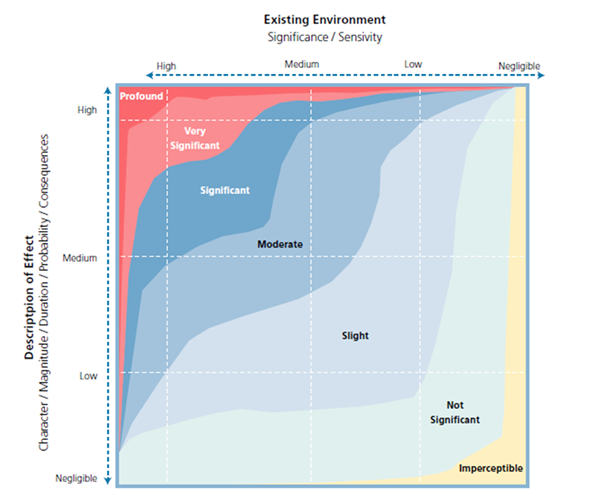
Extract of Figure 3.4 (EPA, EIAR Guidelines (2022))
At scoping stage, where available information indicates that a likely effect could reasonably result in a significant effect, that matter shall be scoped into the EIAR for full assessment. Effects that are reasonably expected to be imperceptible, slight or not significant, having regard to both magnitude and sensitivity, may be proposed for scoping out, subject to clear and reasoned justification (see section 9 below).
In forming this judgement, applicants should have regard to the characteristics of the effect, including its nature, extent, duration, frequency and reversibility, together with the value, sensitivity and resilience of the receiving environment. Consideration should also be given to the potential for interaction or cumulative effects.
Applicants shall not be expected to undertake detailed assessment at scoping stage. However, the rationale for conclusions on likely significance shall be clearly explained and supported by proportionate evidence or professional judgement.
For consistency across disciplines, applicants are encouraged to apply the EPA classification of effects (Table 3.4, EPA EIAR Guidelines (2022)) across environmental factor chapters within the EIAR, unless topic‑specific guidance clearly justifies an alternative approach.
This judgement should be informed by the criteria set out in Annex III of the EIA Directive and applied using proportionate professional judgement, consistent with the EPA EIAR Guidelines (2022)
7.4 What level of evidence or justification is An Coimisiún Pleanála expecting?
At scoping stage, applicants shall provide clear, proportionate and reasoned justification to support the scoping proposals set out in the Scoping Report. The level of detail provided shall reflect the nature of the potential effect, the sensitivity of the receiving environment, and the degree of uncertainty, consistent with the EPA EIAR Guidelines (2022).
Where subtopics, headings or effects are proposed to be scoped out, applicants shall clearly explain the basis for this position, having regard to:
- Baseline environmental conditions and sensitivities;
- The characteristics and scale of the proposed development;
- The presence or absence of credible pathways for significant effects;
- Relevant standards, guidance or established best practice;
- and Professional judgement, where appropriate.
Examples of proportionate evidence and justification appropriate to scoping are set out in Section 9 of this Guide.
7.5 How do mitigation measures affect whether something is scoped in or out?
Where mitigation measures are integral to the project design, they may be taken into account when determining whether an effect is likely to be significant at scoping stage.
However, where the effectiveness of mitigation is uncertain, untested or dependent on future design decisions, the effect shall be scoped into the EIAR and assessed in full, with residual significance evaluated following the application of mitigation.
8. Baselines for Environmental Assessment
8.1 Baseline
It is important that the appropriate baseline environment is established. This is of particular relevance where the site is the subject of other permissions, permits or licences which require compliance/completion.
As set out in the EPA EIAR Guidelines (2022):
The description of the baseline scenario needs to be sufficiently accurate to provide a reliable reference against which effects can be assessed and against which environmental monitoring of the effects of the project can be measured (where relevant).
This may provide that the baseline environment is, as currently exists or the likely future receiving environment, or a combination of both. This should be clearly set out as it relates to each environmental factor.
As set out in the EPA EIAR Guidelines (2022):
It is important to ensure in any event that the worst-case scenario is assessed. This is the scenario that would be likely to give rise to the most significant environmental impacts.
8.2 Continuation of Operational Life
Circular CEPP 1/2026, dated 9th January 2026, provides some clarity in respect of the proposals to continue the operational life of an existing windfarm, where no physical change would arise and repowering proposals where existing turbines are replaced.
Proposals for the continuation of operational life or life extension of an existing windfarms do not include any physical works to the site or turbines. The Circular clarifies that “the baseline should reflect the current status of the environment and the site as it exists at the time of the application, rather than conditions prior to the existing renewable energy development being in place”.
8.3 Repowering
The Circular also provides advice in respect of the consideration of the baseline environment for repowering proposals noting that this is specifically referenced in Article 16X of the RED III Directive. It is outlined that “proposals involving the replacement or renewal of an existing plant (including the full or partial replacement of installations or operating systems and equipment), whether or not accompanied by revised turbine locations or ancillary works, will generally be considered as repowering. Where environmental assessment (including EIA screening or EIA) is required for repowering, it is to be limited to the potential impacts arising from the change or extension compared to the original project”.
It should be noted that the Circular specifically states that “proposals that add new turbines or generation capacity without replacing existing installations will generally be treated as new renewable energy development projects”.
It should be noted that the Circular specifically states that “proposals that add new turbines or generation capacity without replacing existing installations will generally be treated as new renewable energy development projects”.
It should also be noted that situations may arise where existing windfarms are being repowered, but the application site boundary differs from that originally proposed. In this particular circumstance the Circular advises, “while proposed alterations to the application site boundary do not definitively exclude an application from being treated as repowering (i.e. alterations to site access arrangements or amendments to ancillary aspects of the previously permitted development), proposals which, in substance, amount to new generation on areas beyond those assessed as part of the original project (whether or not such areas fall within an amended red line boundary) will also generally be treated as new renewable energy development. This distinction is intended to ensure that the concept of repowering is not applied so broadly as to undermine the RED III requirement that environmental assessment for repowering be confined to the change or extension relative to the original development”. It is advised that the consideration of this matter as it relates to specific proposals will be considered during the pre-application consultation process.
9. Consideration of Environmental Factors
9.1 Overview
This section sets out the contents that shall be addressed for each environmental factor within a Scoping Report. It is not intended to prescribe the structure, headings or format of the report. The contents of this section is not exhaustive, and applicants should also have regard to the EIA Directive (Directive 2011/92/EU, as amended by Directive 2014/52/EU), the EPA EIAR Guidelines (2022), the Wind Energy Development Guidelines (2006) and any other relevant guidance or best practice, as appropriate to the nature, scale and location of the proposed development.
The scope and level of detail of information provided shall be proportionate, having regard to the characteristics of the proposed development and the sensitivity and context of the receiving environment.
The information provided for each environmental factor shall address:
- The context and relevance of the factor;
- The appropriate baseline environment, at a level sufficient to understand receptor sensitivity;
- Key issues and scope, including potential effects and scoping conclusions;
- The proposed assessment methodology, where assessment is intended at EIAR stage; and
- Preliminary mitigation measures, where relevant to informing scoping.
Applicants may present this information in any appropriate format, provided that scoping decisions are clearly explained and robustly justified. The sections that follow provide topic‑specific guidance and illustrative examples of the types of information that may be included under the headings set out above for each environmental factor. These examples are intended to assist in identifying, at scoping stage, the matters that may be relevant to the identification of likely significant effects and the definition of a proportionate scope of assessment primarily for new onshore windfarms. Information relevant to the continuation of operational life and repowering are provided below.
9.2 Scoping Out
As outlined in the EPA EIAR Guidelines (2022), environmental factors cannot be scoped out in their entirety and must always be identified and addressed within the EIAR. However, the scope and level of detail of assessment for an environmental factor may be made proportionate through the scoping out of subtopics, headings, or assessment components within that factor.
For the purposes of this Guide, scoping operates through the following related mechanisms:
Scoping out applies to specific subtopics, headings or potential effects where it can be clearly demonstrated, on the basis of proportionate evidence and reasoned professional judgement, that no credible pathway exists for a likely significant effect to arise. Such subtopics or headings do not require further assessment within the EIAR.
This approach is consistent with the EIA Directive, which requires assessment of likely significant effects, but does not require assessment of effects for which no credible pathway to significance exists.
Accordingly, where it can be demonstrated that an environmental factor gives rise to no likely significant effects, that factor cannot be fully scoped out, but may be addressed at a reduced level of detail, proportionate to its relevance through:
- The scoping out of individual subtopics, headings, or effects; and
- Where justified, the removal of the requirement for a standalone chapter.
In such circumstances, the environmental factor shall still be clearly identified and considered within the EIAR. Where the reduced scope does not warrant a standalone chapter, the relevant information may be presented within a consolidated ‘Other Environmental Factors’ chapter, provided that:
- The environmental factor is explicitly identified;
- The subtopic, heading, or effect considered are clearly defined; and
- The rationale for reduced coverage is transparently explained.
This is a matter of proportionality and presentation and does not remove the requirement to address all environmental factors within the EIAR.
The sections that follow demonstrate how these principles may be applied in practice for different types of onshore wind development for each environmental factor, having regard to the nature of the proposed development and the sensitivity and context of the receiving environment with examples of proportionate evidence provided for each factor. Guidance is generally applicable across development scenarios; scenario‑specific sections therefore address only additional considerations relevant to each case.
The subtopics, heading, or effects identified are not exhaustive, and the examples of evidence referenced are illustrative only and are not intended to be limiting. This may include, where justified, the decommissioning phase, which is typically assessed as giving rise to effects no worse than those arising during construction.
This proportionate approach is acceptable provided that all likely significant effects are robustly identified and scoped into the EIAR, and that the rationale for scoping decisions is clearly documented and supported by evidence/professional judgement.
In applying the principles of scoping out, it should be remembered that for RED III developments (as outlined in the legislative requirements in section 4 above), the Scoping Opinion defines and fixes the scope and level of detail of the EIAR which cannot be subsequently extended, and applicants are required to adhere to that scope once issued.
9.3 Scoping Table
To support consistency and transparency, applicants are encouraged to clearly document and carry forward the agreed scope from the Scoping Report into the EIAR. The use of a structured Scoping Table is encouraged, an example of which is presented below.
Example scoping table:
| Environmental Topic / Potential Effect | Relevant Development Phase(s) | Proposed Scope of Assessment | Rationale for Scoping Decision |
|---|---|---|---|
| Environmental issue being considered | Relevant project phase(s) (e.g. construction, operation, decommissioning) | Whether scoped in, or scoped out | Justification for the scoping decision |
At Scoping Report stage, the Scoping Table should clearly set out, for each environmental factor and relevant matter:
- The proposed scope of assessment;
- Whether specific subtopics, headings or effects are scoped in or scoped out;
- The rationale for each scoping decision; and
- The evidence or professional judgement relied upon.
Once a Scoping Opinion has been issued, the Scoping Table should be adapted and carried forward into the EIAR, updated as necessary to reflect the scoping decisions confirmed by An Coimisiún Pleanála. This provides a clear and auditable means of demonstrating that the EIAR has been prepared in accordance with the issued Scoping Opinion.
9.4 Population and Human Health
Context
Population and Human Health is a relevant consideration for onshore wind development where people or communities may be affected through changes to environmental conditions, land use or amenity. Consistent with the EPA EIAR Guidelines (2022), assessment at scoping stage should focus on the identification of likely significant effects on population receptors and people, rather than the provision of a general socio‑economic profile of the area.
For onshore wind development, population and human health effects most commonly arise indirectly, through other environmental factors, including noise, shadow flicker, traffic, residential visual amenity, land‑use interactions and the accumulation of effects. The Scoping Report should clearly and briefly explain how population‑related considerations (such as settlement patterns, receptor distribution and exposure pathways) and human health considerations will be addressed within the EIAR, whether through a standalone Population and Human Health chapter or, where appropriate, through clearly defined and cross‑referenced assessments within the chapters.
Baseline Environment
At scoping stage, the baseline should be proportionate and sufficient to identify population receptors and potential exposure pathways. It should not extend to detailed socio‑economic analysis unless clearly justified by the presence of a credible pathway for likely significant effects.
Baseline information should enable an understanding of who may be affected and how, and typically include:
- Settlement patterns and population distribution, including identification of communities and dispersed dwellings that could plausibly be affected;
- Identification of sensitive population receptors and Noise Sensitive Locations, such as dwellings, health buildings, places of worship or other community facilities;
- Land use patterns relevant to population exposure, including residential, recreational or community uses;
- Existing environmental stressors relevant to amenity and cumulative exposure (e.g. roads, existing wind farms); and
- Baseline context for key pathways likely to inform later assessment (e.g. haul routes through settlements, quiet rural soundscapes).
Baseline population and demographic information should be sufficient to demonstrate stability or sensitivity, with more detailed analysis only required where a credible pathway for likely significant population effects is identified.
Key Issues and Scope
Population and human health subtopics or effects are likely to require further assessment at EIAR stage where one or more of the following apply:
- Proximity of turbines or associated infrastructure to dwellings or other Noise Sensitive Locations, indicating potential for noise or vibration related effects on people and communities;
- Presence of occupied buildings within applicable shadow flicker screening distances, indicating potential for effects on residential or workplace amenity;
- Construction or abnormal traffic routing through or near settlements, with potential for effects on community amenity, severance or safety;
- Residential visual amenity effects, where turbines are prominent in close‑range views experienced by residents, typically addressed within the Landscape and Visual assessment; and/or
- Credible potential for cumulative exposure, where multiple wind farms or other infrastructure projects may affect the same communities through one or more shared pathways.
Assessment Methodology
Where Population and Human Health effects are scoped into the EIAR, the assessment methodology should address:
- Confirmation that effects will be described and evaluated in accordance with the EPA EIAR Guidelines (2022);
- Identification of the relevant population receptors, exposure pathways and development phases considered;
- The approach to addressing population related effects through the relevant topic specific assessments, including:
- Noise and Vibration, applying relevant guidance;
- Shadow Flicker, with reference to the parameters set out in the Wind Energy Development Guidelines (2006) and recommendations within the draft 2019 Guidelines;
- Traffic and Transport, where community related effects may arise; and
- Cumulative effects, where communities may experience combined exposure across one or more pathways.
- Definition of the intended study area(s), proportionate to the nature of the potential effects and the sensitivity of the receiving environment.
Preliminary Mitigation Measures
Preliminary mitigation principles may include:
- Layout refinement, micrositing and setbacks;
- Commitment to a Construction Traffic Management Plan (CTMP);
- Shadow flicker control measures, where required;
- Construction Environmental Management Plan (CEMP) measures relating to noise, dust, working hours and community liaison; and
- Monitoring and responsive management, where later assessment identifies a potential risk pathway.
Scoping Out
Population and Human Health effects are in some instances scoped out through cross‑reference to other relevant chapters, or, where appropriate, addressed within an ‘Other Environmental Factors’ chapter, rather than through a standalone assessment.
For onshore wind development, population‑related considerations typically relate to the spatial distribution of people and land uses, rather than to changes in population size, structure or employment. Matters such as settlement patterns, land‑use context, baseline population characteristics and demographic trends are primarily relevant insofar as they inform the identification of receptors and exposure pathways for amenity‑related effects (e.g. noise, shadow flicker, traffic or visual amenity).
Operational onshore wind developments do not generally give rise to activities that would result in direct effects on population characteristics, including employment levels, population growth or demographic change. Employment effects are usually limited to short‑term construction activity and do not typically give rise to likely significant effects requiring detailed assessment under the Population and Human Health factor.
Accordingly, specific subtopics, headings or effects within the factor may be scoped out, where proportionate evidence demonstrates
that:
- Settlement patterns, land‑use context and baseline population information have been used to identify relevant receptors and exposure pathways, but do not indicate the potential for population‑level change;
- Noise, shadow flicker, traffic and residential visual amenity effects are fully addressed within the relevant topic‑specific chapters;
- There is no credible pathway for significant effects on employment, population distribution or demographic trends arising from the proposed development; and
- No additional population‑related cumulative effects arise beyond those captured through the cumulative assessment of amenity‑related pathways.
9.5 Biodiversity
Context
The Scoping Report should clearly and briefly explain the relevance of biodiversity to the proposed development, having regard to the potential for effects on habitats, species and ecological processes, including designated sites, protected species and sensitive habitats.
Baseline Environment
Baseline information should be sufficient to identify ecological sensitivities and potential pathways for effect and typically include:
- A desk based review of European sites, NHAs and other designated sites within an appropriate study area, informed by the potential ecological pathways (e.g. hydrological connectivity);
- Habitat information sufficient to inform scoping, derived from available desk‑based sources and, where available, walkover survey information (e.g. Phase 1 Habitat Survey or equivalent); and
- A review of available protected species records, including mammals such as bats and otter, and other species of conservation concern.
Key Issues and Scope
Biodiversity subtopics or effects are likely to require full assessment at EIAR stage where one or more of the following apply:
- Presence of European sites or other designated ecological receptors within the study area, with potential for:
- habitat loss;
- disturbance; and/or
- hydrological connectivity.
- Evidence or reasonable likelihood of protected species occurring within the site or its functional area;
- Presence of semi‑natural habitats, peatland, wetlands or other habitats of higher ecological value; and
- Credible pathways for:
- direct habitat loss;
- disturbance or displacement; and/or
- cumulative ecological effects with other developments.
Assessment Methodology
Assessment methodology should address:
- The proposed ecological survey and assessment approach, where required, including justification for survey type, timing and extent, informed by receptor sensitivity, baseline conditions and the presence of credible pathways for likely significant effects;
- The approach to evaluating impact magnitude, receptor value and significance, consistent with the CIEEM Guidance (2024), which is ecology specific, is advised.
- The approach to cumulative biodiversity effects, including cumulative habitat loss or fragmentation, where relevant; and
- The basis for any reliance on existing ecological data or reduced survey effort, including confirmation of data currency, relevance and limitations, and the professional judgement applied at scoping stage.
Preliminary Mitigation Measures
Preliminary mitigation principles may include:
- Micrositing and design led avoidance of sensitive habitats;
- Appropriate buffer zones to watercourses and ecological features;
- Commitment to pre construction surveys, where required; and
- Habitat protection, reinstatement or restoration measures, where relevant.
Scoping Out
Biodiversity effects may be scoped out where baseline conditions within and surrounding the site demonstrate a low sensitivity receiving environment and the absence of credible pathways for likely significant effects, consistent with current best practice in the EPA 2022 Guidelines and CIEEM Guidance (2024).
Where baseline information demonstrates characteristics including, but not limited to, agriculturally improved land, the absence of statutory or non‑statutory ecological designations, no records of protected species, and limited habitat diversity, biodiversity and nature conservation effects are unlikely to be significant. In such circumstances, assessment may be proportionately focused on baseline surveys and desk‑based appraisal to confirm habitat and species absence, without the need for detailed modelling or extended species‑specific survey effort. This targeted, risk‑based approach is consistent with the case‑by‑case assessment principles set out in the Wind Energy Development Guidelines (2006).[3]
[3] An EIAR for an onshore wind farm in Ireland should primarily reference the Wind Energy Development Guidelines 2006, because they remain the statutory guidelines currently in force. The Draft Revised Guidelines (2019) may be referenced as non‑statutory, emerging guidance as they await finalisation by the Department which according to CAP 2025 - Action Number <EL/24/5 were to be published in Q1 of 2025. Until such time, the existing guidelines remain in force but applicants can opt to apply key elements of the draft guidelines in terms of the proposed development – such as the minimum set back of 4 x tip height and zero-shadow flicker.
Biodiversity remains an environmental factor within scope of the EIAR. However, where no credible pathway for likely significant effects is identified, the level of assessment may be proportionate to reflect receptor sensitivity, the nature and extent of the proposed works, and the anticipated magnitude of change.
This approach is acceptable where proportionate evidence demonstrates that:
- A Preliminary Ecological Appraisal and/or Phase 1 Habitat Survey has been completed within two years of the scoping request, sufficient to inform receptor sensitivity and potential effect;
- Habitats and species within the study area have been identified and characterised;
- Baseline evidence confirms:
- the absence of statutory and non‑statutory ecological designations within the relevant study area; and
- the absence of suitable supporting habitat for protected species;
- A risk‑based justification is provided for limiting further ecological survey or assessment, having regard to the nature of the proposed development and baseline sensitivities; and
- Standard mitigation measures and commitments are identified, including appropriate buffers, construction controls, invasive species management measures.
- Note – if follow‑up surveys and/or monitoring are required to determine any of the above, a credible pathway may exist and it may not be appropriate to scope out the effect.
9.6 Ornithology
Context
The Scoping Report should clearly and briefly explain the relevance of ornithology to the proposed development, with particular regard to potential effects on bird species through collision, displacement or barrier effects. Ornithological considerations are particularly relevant where development is proposed in areas that may support sensitive bird populations or migration pathways.
Baseline Environment
Baseline information should be sufficient to identify ornithological sensitivity and potential risk pathways and typically include:
- A desk based review of designated sites (e.g. SPAs), protected species records and relevant ornithological data within an appropriate study area;
- Consideration of known raptor territories, key breeding or foraging areas, and migratory routes;
- Relevant surveys: and
- Reference to site characteristics (such as upland peatland, open or exposed landscapes, or other habitats and landscape contexts known to be associated with higher ornithological sensitivity).
Key Issues and Scope
Ornithological subtopics or effects are likely to require full assessment at EIAR stage where one or more of the following apply:
- Presence of European sites or other designated ornithological receptors within the study area, with potential for:
- collision risk;
- displacement or disturbance; and/or
- barrier effects affecting flight lines or connectivity.
- Evidence or reasonable likelihood of sensitive bird species occurring within the site or its functional area, including:
- raptors;
- Annex I species; and/or
- regularly occurring migratory assemblages.
- Site characteristics that are known to be associated with elevated ornithological sensitivity, including:
- upland peatland or open moorland; and/or
- wetlands; and/or
- ridge lines, saddles or known flight corridors.
- Credible pathways for:
- turbine collision or displacement effects;
- disturbance during construction or operation; and
- cumulative ornithological effects with other wind energy developments.
Assessment Methodology
Assessment methodology should address:
- The proposed survey approach, including vantage point methodology and justification for survey duration and extent, consistent with guidance and best practice.
- The intended approach to collision risk assessment, including modelling principles where relevant;
- The approach to cumulative assessment, including identification of other wind energy developments to be considered; and
- The Intended study area(s).
Preliminary Mitigation Measures
Preliminary mitigation principles may include:
- Turbine layout and design to avoid key flight lines or sensitive areas;
- Design led avoidance of high risk locations; and
- Operational controls or curtailment, where later assessment identifies a need.
Scoping Out
Ornithological effects may be scoped out where baseline information within and surrounding the site indicates a low sensitivity ornithological receiving environment and the absence of credible pathways for likely significant effects.
Where baseline information demonstrates characteristics including, but not limited to, absence of designated ornithological sites, limited availability of suitable habitats, low bird activity, and no evidence of significant flight lines or key receptors within the study area, ornithological effects are unlikely to be significant. In such circumstances, assessment may be proportionately focused on targeted baseline data collection and desk‑based appraisal to confirm low sensitivity and limited interaction potential, without the need for extended seasonal surveys or detailed collision risk modelling subject to the best practice methodology being followed.
Ornithology remains an environmental factor within scope of the EIAR. However, the extent, duration and intensity of survey effort and assessment should reflect receptor sensitivity, site context and landscape setting, and the likelihood of significant effects arising, consistent with the case‑by‑case assessment approach set out in the Wind Energy Development Guidelines (2006) subject to the best practice methodology being followed.
This approach is acceptable where proportionate evidence demonstrates that:
- A desk‑based review of existing ornithological records and designated sites within the study area has been undertaken;
- Habitats with potential to support breeding, wintering or migratory bird species are absent;
- Baseline evidence confirms:
- the absence of European sites or nationally designated ornithological receptors; and
- the presence of low‑sensitivity bird assemblages;
- A risk‑based justification is provided for targeted or reduced survey effort and for the absence of credible collision or displacement pathways; and
- Standard mitigation measures and commitments are identified, including appropriate buffers, construction controls.
- Note – if follow‑up surveys and/or monitoring are required to determine any of the above, a credible pathway may exist and it may not be appropriate to scope this out.
9.7 Land and Soils (including Peat)
Context
The Scoping Report should clearly and briefly explain the relevance of land, soils and peat to the proposed development with relevant considerations including the potential of ground disturbance, excavation, or drainage works to affect soil resources, peat stability, land use, geology such as limestone or karst environments or associated environmental receptors.
Baseline Environment
Baseline information should enable identification of land and soil sensitivities and potential pathways for effect and typically include:
- Desk‑based information on soil types, peat presence and land use;
- Identification of areas of peat or carbon‑rich soils, where present;
- Description of topography, slope conditions and any known drainage or stability sensitivities; and
- Identification of potential linkages with water and biodiversity receptors.
Key issues and Scope
Land and soils subtopics or effects are likely to require full assessment at EIAR stage where one or more of the following apply:
- Presence of peat or carbon‑rich soils, particularly where:
- excavation, drainage or loading is proposed; and/or
- peat depth or stability is uncertain.
- Evidence of slope instability, landslide susceptibility or sensitive ground conditions.
- Proposed works with the potential for:
- significant ground disturbance; and/or
- alteration of landform or drainage patterns.
- Credible pathways for:
- peat instability or failure;
- loss or degradation of carbon‑rich soils; and/or
- cumulative land or peat effects across shared hydrological or slope systems.
Assessment Methodology should address:
- The intended risk‑based approach to land, soils and peat assessment, whereby the scope and extent of survey and assessment at EIAR stage are informed by receptor sensitivity;
- The proposed survey and assessment types to be undertaken at EIAR stage, where relevant;
- The intended study area(s) for land and soil assessment; and
- The approach to considering cumulative land and peat effects, where relevant.
Preliminary mitigation measures
Preliminary mitigation principles may include:
- Design‑led avoidance and micrositing to minimise ground disturbance;
- Peat management and drainage control principles, where relevant; and
- Measures to be secured through an Outline Construction Environmental Management Plan, including soil handling and reinstatement practices.
Scoping Out
Land and soils effects may be scoped out where baseline information within and surrounding the site demonstrates low ground sensitivity and the absence of credible pathways for likely significant effects.
- Desk‑based information has been reviewed to characterise:
- soils;
- peat presence; and
- ground stability;
- Baseline evidence confirms the presence of low‑sensitivity soils and the absence of peat or carbon‑rich soils;
- A high‑level geotechnical or soils statement confirms the suitability of ground conditions for the proposed development; and
- Standard construction controls and commitments are identified, including measures to manage soil handling, drainage and ground disturbance.
9.8 Water (Hydrology and Hydrogeology)
Context
The Scoping Report should clearly and briefly explain the relevance of hydrology and hydrogeology to the proposed development with particular regard to surface waters, groundwater or wetlands through earthworks, drainage, watercourse crossings or changes to runoff patterns.
Baseline Environment
Baseline information should enable identification of water‑related sensitivities and pathways and typically include:
- Identification of surface water features, wetlands and groundwater bodies within an appropriate study area;
- Identification of any water‑dependent designated sites and relevant hydrological connections; and
- Identification of private and public water supplies.
Key issues and Scope
Water related subtopics or effects are likely to require full assessment at EIAR stage where one or more of the following apply:
- Presence of water dependent designated sites within the study area, with potential hydrological connectivity;
- Proposed works involving:
- watercourse crossings;
- in stream works; and/or
- drainage alteration or abstraction/discharge.
- Evidence of sensitive receptors, including:
- high status water bodies;
- private and public water supplies; and/or
- wetlands or groundwater dependent ecosystems.
- Credible pathways for:
- sediment or pollution release;
- alteration of flow regimes; and/or
- cumulative hydrological or hydrogeological effects within the same catchment.
Assessment methodology
Assessment Methodology should address:
- Proposed study areas and assessment framework;
- Relevant surveys and testing;
- Use of pathway based assessment aligned with the EPA EIAR Guidelines (2022); and
- The basis for screening effects by project phase, including confirmation of where construction or decommissioning effects are not expected to give rise to likely significant effects having regard to the nature, scale and duration of works.
Preliminary mitigation measures
Preliminary mitigation principles may include:
- Standard drainage and pollution prevention measures;
- Buffering of watercourses and sensitive features; and
- Construction controls to be secured through an Outline Construction Environmental Management Plan.
Scoping Out
Water‑related effects may be scoped out where baseline conditions within and surrounding the site demonstrate low hydrological and hydrogeological sensitivity and the absence of credible pathways for likely significant effects.
Where, for example, turbines, access tracks, water crossings and ancillary infrastructure are located outside the zones of influence of sensitive water features, no new abstractions or discharges are proposed, and embedded drainage and pollution prevention measures form part of the design, water‑related effects are unlikely to be significant. In such circumstances, assessment may be proportionately focused on confirming baseline conditions and potential pathways, without the need for detailed modelling or site‑specific investigation at scoping stage.
Hydrology and hydrogeology remain environmental factors within scope of the EIAR. However, the level and extent of assessment should reflect receptor sensitivity, site context and the nature of potential pathways, consistent with a proportionate, risk‑based approach to EIA as set out in the EPA EIAR Guidelines (2022).
This approach is acceptable where proportionate evidence demonstrates that:
- Surface water and groundwater receptors within the study area have been identified and characterised;
- Potential hydrological and hydrogeological pathways have been identified and assessed at a conceptual level;
- Baseline evidence confirms:
- the absence of sensitive water‑dependent designated sites or receptors; and
- no requirement for new abstractions, discharges or in‑stream works and crossings;
- Embedded drainage and pollution prevention measures form part of the project design; and
- Standard mitigation measures and commitments are identified, including controls to be secured through a construction environmental management plan.
9.9
Landscape and Visual
Context
The Scoping Report should clearly and briefly explain the relevance of landscape and visual amenity with the potential for turbines to alter landscape character and affect views experienced by residential, recreational and community receptors.
Baseline Environment
Baseline information should enable understanding of landscape sensitivity and visual context and typically include:
- Identification of landscape character types within the study area;
- Identification of landscape designations or sensitive landscapes;
- Description of the existing visual context, including the presence of existing wind farms; and
- Identification of key visual receptors, including residential properties and scenic viewpoints and routes, recreational receptors.
Key issues and Scope
Landscape and visual subtopics or effects are likely to require full assessment at EIAR stage where one or more of the following apply:
- Presence of designated landscapes or landscapes of high sensitivity within the study area;
- Evidence of potential visibility from:
- residential receptors;
- key recreational or community receptors;
- sensitive viewpoints.
- Proposed development with:
- large turbine numbers or height;
- prominent siting on ridgelines or elevated landform.
- Credible pathways for:
- significant landscape character change;
- significant effects on visual amenity;
- cumulative landscape or visual effects with other wind energy developments.
Assessment methodology
Assessment Methodology should address:
- The approach to establishing the significance of effects, consistent with EIAR practice; and
- The intended use of Zone of Theoretical Visibility (ZTV) mapping, viewpoints and visualisations;
- The approach to the selection of representative viewpoints and visualisations, informed by ZTV analysis, receptor sensitivity and the existing wind energy context, to ensure assessment is proportionate and focused on likely significant effects.
- The definition of study areas, informed by landscape character and visibility.
Preliminary mitigation measures
Preliminary mitigation principles may include:
- Design measures to limit visual clutter and cumulative effects; and
- Avoidance of sensitive landscape features where practicable.
Scoping Out
Landscape and visual effects may be scoped out where baseline conditions within and surrounding the site demonstrate low to moderate landscape sensitivity, a limited number of sensitive visual receptors, and the absence of credible pathways for likely significant effects.
Where baseline demonstrates characteristics including, but not limited to, the absence of designated scenic landscapes, limited visibility of turbines due to landform or vegetation, and a low number of residential or highly sensitive visual receptors, landscape and visual effects are unlikely to be significant. In such circumstances, assessment may be proportionately focused on a reduced study area, a targeted selection of representative viewpoints, and an appropriate level of visualisation, informed by preliminary Zone of Theoretical Visibility (ZTV) analysis.
Landscape and visual amenity remain environmental factors within scope of the EIAR. However, the extent and level of assessment should reflect landscape character, receptor sensitivity and the scale and visibility of the proposed development, consistent with established EIAR practice for onshore wind development.
This approach is acceptable where proportionate evidence demonstrates that:
- Landscape character types and designations within the study area have been identified;
- Preliminary ZTV mapping has been undertaken to inform visibility and study area definition;
- Baseline evidence confirms:
- the absence of designated scenic landscapes or highly sensitive landscape receptors; and/or
- limited visibility from residential or other sensitive receptors;
- A reasoned justification is provided for the proposed study area, number and location of viewpoints; and
- Standard design and mitigation principles are identified to limit landscape and visual effects.
9.10 Noise and Vibration
Context
The Scoping Report should clearly and briefly explain the relevant considerations as they relate to noise and vibration where construction activities or operational turbines have the potential to affect Noise Sensitive Locations (NSLs), including dwellings and other sensitive receptors.
Baseline Environment
Baseline information should enable identification of receptors and the receiving environment and typically include:
- Location and distribution of Noise Sensitive Locations within an appropriate study area;
- Description of the existing noise environment, including rural or urban character and the influence of existing wind farms or other noise sources; and
- Identification of any receptors/NSL potentially subject to cumulative noise exposure.
Key issues and Scope
Noise and vibration subtopics or effects are likely to require full assessment at EIAR stage where one or more of the following apply:
- Presence of Noise Sensitive Locations within distances where:
- operational turbine noise may be perceptible; and/or
- construction noise may be prolonged or intensive.
- Proposed turbine layout or technology with:
- potential for tonal noise, low frequency noise or amplitude modulation.
- Evidence of existing noise constraints or cumulative exposure from:
- other wind farms; and/or
- transport or industrial sources.
- Credible pathways for:
- exceedance of relevant noise criteria; and/or
- cumulative operational noise effects.
Assessment methodology
Assessment Methodology should address:
- The intended approach to the assessment and any supporting survey of noise and vibration, with reference to the Wind Energy Development Guidelines (2006) and consistent with the EPA EIAR Guidelines (2022) and other relevant standards/best practice; and
- The approach to defining study areas and selecting representative receptors.
Preliminary mitigation measures
Preliminary mitigation principles may include:
- Turbine layout refinement and separation distances;
- Construction management measures, including working hours and activity controls; and
- Operational controls where required to ensure compliance including for special noise character.
Scoping Out
Noise and vibration effects may be scoped out where baseline noise conditions, receptor distribution and the characteristics of the proposed development indicate a low likelihood of significant effects.
Where baseline noise levels are low, construction activities are temporary and localised, and preliminary appraisal indicates that operational noise can comply with the criteria set out in the Wind Energy Development Guidelines (2006), noise and vibration effects are unlikely to be significant. In such circumstances, assessment may be proportionately focused and may include the scoping out of certain noise and vibration subtopics, for example:
- Construction vibration;
- Operational vibration;
- Maintenance traffic noise; and
- Decommissioning noise.
In these cases, assessment may be proportionately focused on screening‑level appraisal and targeted quantitative assessment at representative Noise Sensitive Locations, without the need for extensive baseline monitoring or modelling at scoping stage.
Noise and vibration remain environmental factors within scope of the EIAR. However, the extent and level of assessment should reflect receptor sensitivity, duration of activities and the likelihood of exceedance of relevant guidance limits, consistent with a proportionate, evidence‑led approach.
This approach is acceptable where proportionate evidence demonstrates that:
- Noise Sensitive Locations within the study area have been identified and mapped;
- Baseline noise conditions have been characterised at a sufficient level;
- Preliminary appraisal indicates compliance with the relevant construction and operational noise and vibration criteria;
- The duration and nature of construction activities have been defined; and
- Standard mitigation measures and commitments are identified, including construction management measures and operational controls where required including operational noise character (AM and tonal)
9.11
Shadow Flicker
Context
Shadow flicker is a potential operational effect associated with onshore wind turbines where rotating blades intermittently cast moving shadows over occupied buildings, including dwellings and offices.
Baseline Environment
Baseline information should enable identification of receptors potentially affected by shadow flicker and typically include:
- Identification of occupied buildings/extent permissions where people may be present for extended periods, namely dwellings and offices, within the relevant screening distance of the proposed turbines; and
- Description of the general spatial relationship between turbines and receptors (distance, orientation).
Key issues and Scope
Shadow flicker subtopics or effects are likely to require full assessment at EIAR stage where one or more of the following apply:
- Presence of occupied buildings, including dwellings or offices, extant permissions within relevant shadow flicker screening distances;
- Turbine layout, height or orientation that could give rise to periodic shadow casting at receptors;
- Potential for cumulative shadow flicker effects affecting the same receptors; and
- Credible pathways for:
- exceedance of guideline thresholds; and/or
- repeated or prolonged exposure.
Assessment methodology
Assessment Methodology should address:
- Application of the Wind Energy Development Guidelines (2006) parameters (30 hours per year / 30 minutes per day; low potential beyond 10 rotor diameters) and the recommendations set out in the draft 2019 Guidelines.
- Use of recognised shadow flicker modelling software at EIAR stage, where required; and
- Consideration of theoretical and realistic scenarios. Where screening demonstrates no credible pathway, detailed assessment is not be required.
Preliminary mitigation measures
Preliminary mitigation principles may include:
- Turbine micrositing or layout refinement; and
- Operational turbine control or curtailment, where required.
Scoping Out
Shadow flicker effects may arise during the operational phase of onshore wind development where wind turbines are located in proximity to residential receptors and there is potential for periodic shadow casting under particular sun angles and operational conditions. The Wind Energy Development Guidelines (2006) indicate that shadow flicker should not normally exceed 30 hours per year at any dwelling and note that a separation distance of approximately 500 m from residential properties generally limits the potential for such effects to arise. The draft 2019 Guidelines outline that “If a suitable shadow flicker prediction model indicates that there is potential for shadow flicker to occur at any particular dwelling or other potentially affected property, then a review of site design involving the possible relocation of one or more turbines to explore the possibility of eliminating the occurrence of potential flicker is required. Following such a review, if shadow flicker is not eliminated for any dwelling or other potentially affected property then clearly specified measures which provide for automated turbine shut down to eliminate shadow flicker should be required as a condition of a grant of permission”.
Shadow flicker effects may, for example, be scoped out where screening demonstrates the absence of sensitive residential receptors within the relevant screening distance and where site‑specific factors such as turbine layout, orientation and topography indicate no credible pathway for likely significant effects. The use of recognised shadow flicker modelling software can eliminate shadow flicker and is recommended.
As shadow flicker is an operational‑phase effect only, construction and decommissioning phases may be scoped out.
Shadow flicker remains an environmental factor within scope of the EIAR. However, where receptor distribution and the characteristics of the proposed development indicate a low likelihood of significant effects, the level of assessment may be proportionately reduced and confined to confirmation of screening conclusions, consistent with the risk‑based, case‑by‑case approach set out in the Wind Energy Development Guidelines (2006).
This approach is acceptable where proportionate evidence demonstrates that:
- Shadow flicker screening has been undertaken in accordance with the Wind Energy Development Guidelines (2006). and the recommendations set out in the draft 2019 Guidelines;
- Screening confirms no residential receptors within the applicable shadow flicker screening distance;
- A clear statement is provided confirming the absence of a credible operational effect for shadow flicker; and
- Appropriate equipment and computer software is proposed within the turbines.
9.12
Air and Climate
Context
Air quality and climate are relevant considerations for onshore wind development, recognising that air quality effects are generally limited to construction and decommissioning activities, while climate considerations relate primarily to resilience and adaptation rather than operational emissions.
Baseline Environment
Baseline information should describe the general air and climate context and typically include:
- Identification of sensitive receptors in proximity to construction and decommissioning activities;
- Description of the local air quality context;
- Reference to relevant climate‑related constraints, such as flood risk.
Key issues and Scope
Air quality and climate subtopics or effects are likely to require full assessment at EIAR stage where one or more of the following apply:
- Construction and decommissioning activities with:
- extended duration;
- high traffic volumes;
- proximity to sensitive receptors.
- Evidence of existing air quality constraints or sensitive receiving environments;
- Climate related considerations where:
- the proposed development may be vulnerable to flooding or extreme weather; and/or
- site conditions indicate potential resilience or adaptation issues.
- Credible pathways for:
- significant construction phase dust or emissions; and/or
- cumulative air quality effects during overlapping construction periods.
Assessment methodology
Assessment Methodology should address:
- A proportionate, risk‑based approach to air quality assessment, informed by receptor sensitivity and activity scale;
- The intended approach to assessing construction/decommissioning‑phase dust and emissions, where relevant;
- The approach to addressing climate resilience and adaptation, with climate mitigation benefits addressed in policy or project description sections rather than as environmental effects; and
- The intended study area(s).
Preliminary mitigation measures
Preliminary mitigation principles may include:
- Standard dust and emissions control measures; and
- Design measures supporting climate resilience, including drainage and siting considerations.
Scoping Out
Air
Air quality effects may be scoped out where baseline conditions and the nature of the proposed development indicate low‑sensitivity receptors and limited potential for emissions.
Operational onshore wind developments do not typically give rise to routine air quality emissions. Construction‑phase effects are generally short‑term and localised, primarily associated with vehicle movements, earthworks and dust generation.
Where baseline information demonstrates, for example, good air quality, limited construction duration and an absence of nearby sensitive receptors, air quality effects are unlikely to be significant and may be addressed through a qualitative appraisal, supported by standard dust control measures.
Construction‑phase dust and traffic emissions are typically transient, localised and reversible where standard good practice mitigation is applied. Operational‑phase effects are generally negligible, with emissions limited to infrequent maintenance traffic.
Accordingly, where it can be demonstrated that no credible pathway exists for likely significant air quality effects during construction, operation or decommissioning, the effects may be scoped out, with detailed quantitative assessment not required.
Climate (Carbon Balance)
Climate considerations for onshore wind development primarily relate to climate resilience and adaptation, rather than significant adverse environmental effects. Where infrastructure is designed in accordance with current standards and informed by baseline flood risk, drainage and climate context information, climate‑related effects are unlikely to be significant.
Consistent with the EPA EIAR Guidelines (2022), climate mitigation benefits associated with renewable energy development are not, in themselves, environmental effects to be assessed within an EIAR and should therefore not drive scoping decisions. At scoping stage, consideration of climate should focus on whether the proposed development gives rise to likely significant effects related to its vulnerability to climate change and its capacity for resilience and adaptation.
Air and climate remain environmental factors within scope of the EIAR. However, the scope and level of detail of assessment should reflect receptor sensitivity, activity scale and the nature of potential pathways, consistent with EPA EIAR Guidelines (2022).
This approach is acceptable where proportionate evidence demonstrates that:
- Construction activities with the potential to generate dust or emissions have been identified;
- Sensitive receptors within the study area have been identified;
- Baseline air quality and climate context have been described at a level sufficient to inform scoping, informed by desk‑based information on existing air quality, receptor sensitivity and climatic conditions relevant to the proposed development;
- No operational air quality emissions are anticipated; and
- Standard mitigation and embedded design measures are identified, including dust control measures and climate resilience measures (e.g. drainage design, flood risk avoidance).
9.13 Cultural Heritage
Context
Cultural heritage is a relevant consideration where onshore wind development has the potential to affect archaeological, architectural or cultural heritage assets, either directly through land disturbance or indirectly through effects on setting, context, appreciation or the wider cultural heritage landscape.
Baseline Environment
Baseline information should enable identification of heritage sensitivities and typically include:
- Identification of recorded archaeological and architectural heritage assets;
- Description of the heritage landscape context; and
- Reference to the potential for intervisibility between the proposed development and heritage assets, informed by preliminary ZTV analysis and site appraisal, where relevant.
Key issues and Scope
Cultural heritage subtopics or effects are likely to require full assessment at EIAR stage where one or more of the following apply:
- Presence of designated or non designated heritage assets within study area.
- Evidence of potential for:
- direct disturbance of archaeological remains; an/or
- changes to setting, context or appreciation.
- ZTV or site appraisal indicating:
- intervisibility between turbines and heritage receptors.
- Credible pathways for:
- effects on the significance or value of heritage assets; and/or
- cumulative heritage effects with other developments.
Assessment methodology
Assessment Methodology should address:
- The proposed heritage assessment framework, including desk study and field survey where required;
- The approach to screening and assessing effects on heritage assets and their settings, including justification for the inclusion or exclusion of assets from further assessment having regard to distance, visibility, sensitivity, and the potential for perceptible change to significance, informed by ZTV analysis where relevant;
- The approach to considering cumulative heritage effects; and
- The intended study area(s).
Preliminary mitigation measures
Preliminary mitigation principles may include:
- Design‑led avoidance of heritage assets; and
- Archaeological testing, monitoring or preservation measures, where required.
Scoping Out
Cultural heritage effects may be scoped out where baseline information within and surrounding the site demonstrates low heritage sensitivity and the absence of credible pathways for likely significant effects, consistent with the EPA EIAR Guidelines (2022).
Where baseline information demonstrates characteristics including, but not limited to, designated and non‑designated cultural heritage assets located at sufficient distance from the proposed development, lie outside the Zone of Theoretical Visibility (ZTV), and/or where the characteristics of the receiving environment are such that the proposed development would not give rise to perceptible change, cultural heritage effects are unlikely to be significant. In such circumstances, potential effects are limited to negligible changes, including changes to setting, context or appreciation, which would not affect the significance or heritage value of the asset.
Cultural heritage remains an environmental factor within scope of the EIAR. However, detailed assessment of effect, including effects on setting, visual relationships or contextual appreciation, is only required where site‑specific appraisal or ZTV analysis identifies a potential for perceptible change with the capacity to affect the significance of a heritage asset, consistent with the case‑by‑case assessment approach set out in the Wind Energy Development Guidelines (2006).
This approach is acceptable where proportionate evidence demonstrates that:
- A desk‑based review of designated and non‑designated cultural heritage assets within the study area has been undertaken;
- Zone of Theoretical Visibility (ZTV) analysis has been used to inform potential visual and setting‑related pathways;
- Baseline evidence confirms:
- sufficient distance between the proposed development and heritage assets; and
- effective screening by landform and/or vegetation; and
- A clear justification is provided for the absence of intrusive survey where no credible impact pathway exists.
9.14 Material Assets
Context
Material assets are relevant where onshore wind development may interact with transport networks, waste management systems, infrastructure, aviation interests or telecommunications systems.
Baseline Environment
Baseline information should enable identification of relevant infrastructure, constraints and waste pathways and typically include:
- Identification of construction access routes and the local road network;
- Description of nearby settlements and receptors relevant to traffic effects;
- Identification of known aviation and telecommunications constraints;
- Identification of existing waste management infrastructure relevant to the proposed development, including availability of licensed facilities for construction and demolition waste; and
- Identification of any site‑specific constraints relevant to waste management, such as limited access, remote locations or environmentally sensitive receptors.
Key issues and Scope
Material assets subtopics or effects are likely to require further assessment at EIAR stage where one or more of the following apply:
- Traffic:
- Construction or abnormal load traffic routing through or near settlements, sensitive receptors or constrained parts of the road network, with potential for amenity, safety or severance effects;
- Requirement for road widening, junction modifications, bridge strengthening or other permanent alterations to transport infrastructure; and/or
- Credible potential for cumulative traffic effects arising from overlapping construction phases with other developments.
- Waste Management:
- Construction or decommissioning activities likely to generate significant quantities of waste, hazardous waste, or surplus excavated material requiring off site disposal or recovery;
- Site specific constraints affecting waste storage, segregation, reuse or transport; and/or
- Credible potential for cumulative waste management effects where multiple developments generate waste within the same locality or timeframe.
- Aviation:
- Presence of safeguarded aerodromes, helipads, radar infrastructure, flight paths or defence interests within the relevant consultation distance of the proposed development;
- Turbine height or layout with the potential to interfere with aviation safety, navigation or radar systems; and/or
- Consultation responses identifying potential aviation constraints or requirements for mitigation.
- Telecommunications:
- Presence of fixed link paths, broadcast infrastructure or telecommunications installations with the potential for interference from turbine structures;
- Evidence that line of sight or signal integrity may be affected; and/or
- Consultation responses identifying potential impacts on telecommunications services.
Assessment methodology
Assessment methodology should address:
- The intended traffic assessment approach, including definition of appropriate study areas, identification of relevant receptors and routes, and proportionate screening against applicable thresholds, with assessment focused on construction and abnormal load traffic where relevant;
- The approach to aviation and telecommunications consultation, including identification of relevant safeguarding bodies, confirmation of consultation distances applied, and the basis for determining whether detailed assessment or mitigation is required;
- The approach to identifying and assessing cumulative material asset effects, where relevant, including consideration of overlapping construction periods, shared infrastructure or common receptors;
- The intended approach to waste assessment, proportionate to the scale and nature of the proposed development, including:
- identification of principal waste streams during construction and decommissioning;
- confirmation that waste will be managed in accordance with the waste hierarchy;
- confirmation that waste will be handled by authorised contractors and disposed of or recovered at licensed facilities; and
- confirmation that detailed waste management measures will be secured through a Construction Environmental Management Plan (CEMP) and, where relevant, a project‑specific Waste Management Plan.
Preliminary mitigation measures
Preliminary mitigation principles may include:
- Commitment to a Construction Traffic Management Plan (CTMP);
- Routing, timing and safeguarding measures for abnormal and heavy goods vehicle movements;
- Application of appropriate waste management practices, consistent with the waste hierarchy, including waste minimisation, segregation, reuse and recycling; and
- Commitment to managing construction and decommissioning waste through the CEMP, including use of licensed facilities and record‑keeping procedures.
Scoping Out
Traffic
Traffic effects at operational stage may be scoped out where baseline conditions and the characteristics of the proposed development indicate a low likelihood of significant effects, with impacts typically confined to the construction phase.
Where baseline information demonstrates that existing access routes are of suitable standard, abnormal loads can be accommodated without highway alteration, and construction traffic volumes are low relative to baseline flows, transport and traffic effects are unlikely to be significant. In such circumstances, effects are generally limited to short‑term construction‑phase vehicle movements and may be proportionately addressed through a high‑level appraisal supported by a Construction Traffic Management Plan (CTMP). Detailed modelling is not normally required where there is no evidence of significant changes to traffic conditions, road safety or severance. For example, the following subtopics are commonly scoped out:
- Operational and decommissioning phase traffic;
Traffic remains an environmental factor within scope of the EIAR. However, the level of assessment should reflect the scale and duration of traffic, receptor sensitivity and the likelihood of significant effects arising.
This approach is acceptable where proportionate evidence demonstrates that:
- Anticipated vehicle movements have been identified by phase (type, number and duration);
- Proposed vehicle routing and access points have been defined;
- The local road network has been characterised;
- Screening against relevant thresholds has been undertaken; and
- A commitment is made to the preparation and implementation of a CTMP.
Waste Generation
Waste‑related effects may be scoped out where the nature of the proposed development indicates that operational waste generation will be minimal and unlikely to give rise to significant environmental effects.
Operational onshore wind developments typically generate limited waste, largely associated with routine maintenance activities. As such, operational waste does not generally give rise to significant effects and may be addressed at a lesser level of detail, with assessment focused on construction and decommissioning waste management only.
Waste remains an environmental factor within scope of the EIAR. However, the scope and level of detail of assessment should be proportionate to the scale and nature of waste arisings and the potential for significant effects.
This approach is acceptable where proportionate evidence demonstrates that:
- Anticipated waste streams and quantities have been identified;
- Waste management will adhere to the waste hierarchy; and
- Appropriate monitoring and management measures will be implemented to ensure compliance.
Aviation and Telecommunications
Aviation and telecommunications effects may be scoped out where consultation confirms the absence of constraints or safeguarding interests and no credible pathway for interference is identified.
Where consultation with relevant stakeholders confirms the absence of safeguarded aerodromes, radar coverage, defence interests or telecommunications constraints, aviation and telecommunications effects are unlikely to arise. In such circumstances, detailed assessment is only required where consultation identifies a potential for interference.
Aviation and telecommunications remain environmental factors within scope of the EIAR. However, where no credible effect is identified, assessment may be limited to consultation evidence and confirmation of constraints, consistent with a proportionate, risk‑based approach.
This approach is acceptable where proportionate evidence demonstrates that:
- Consultation has been undertaken with relevant:
- aviation authorities, defence and radar stakeholders, and telecommunications operators;
- Confirmation has been obtained that no safeguarded aerodromes, radar or telecommunications constraints apply.
9.15 Cumulative Effects
The consideration of cumulative effects is a requirement of the EIA Directive and should be applied proportionately, focusing on those combinations of effects that have the potential to give rise to likely significant cumulative effects.
Cumulative effects may arise either through the interaction of different effects associated with the proposed development itself, or through the cumulation of effects with other existing, permitted or reasonably foreseeable developments. Both aspects should be considered at scoping stage where there is potential for likely significant effects.
The EPA EIAR Guidelines (2022) highlight the need to consider cumulative effects and interactions between effects, recognising that the significance of effects may be influenced by how effects act together.
Cumulation of Effects with Other Relevant Developments
Cumulative effects may arise where the proposed development acts in combination with other developments to affect the same environmental receptor. Such effects may occur during any phase of a proposed development, including construction, operation, or decommissioning.
A fundamental requirement of cumulative effects consideration is the identification of those developments with which the proposed development may reasonably interact to give rise to cumulative effects. This process is commonly referred to as shortlisting.
To support a structured and transparent approach to shortlisting, applicants are encouraged to adopt a staged cumulative effects framework, similar to that set out in the Planning Inspectorate guidance Nationally Significant Infrastructure Projects: Advice on Cumulative Effects Assessment (2024).
Staged Approach to Cumulative Effects Shortlisting (For Consideration)
The staged approach comprises four steps:
- Stage 1 - Long list
- Stage 2 - Short list
- Stage 3 - Information gathering
- Stage 4 – Assessment
For the purposes of EIA scoping, applicants are expected to complete Stages 1 and 2 and to present the outcome in a clear schedule or matrix; Stages 3 and 4 are completed as part of the EIAR where cumulative effects are screened in.
Stage 1 – Identification of Other Relevant Developments
At the scoping stage, applicants should compile a comprehensive list of other developments within a defined cumulative study area or zone of influence (ZOI), appropriate to each environmental factor. The geographic extent of the cumulative study area should be topic‑specific, informed by the nature of the potential effect.
At scoping stage, the level of detail provided should be sufficient to enable an understanding of the scale, nature and location of other developments, without requiring detailed assessment.
The cumulative development long list should focus on developments that are sufficiently defined to support a meaningful and proportionate shortlisting exercise, and should include:
- Operational developments, which form part of the baseline environment;
- Developments under construction;
- Permitted or approved developments that are not yet implemented; and
- Developments in the planning system, where sufficient information is available to allow consideration of their scale, nature and potential for interaction with a proposed development.
The long list should include existing and permitted/approved developments. Other developments in the planning system, and other reasonably foreseeable developments, may be included where sufficient information exists to support meaningful consideration. In defining “reasonably foreseeable”, applicants should apply a proportionate judgement based on the status and certainty of information available. There is no requirement to include speculative or hypothetical proposals for which insufficient information exists to enable a reasoned assessment of potential cumulative interaction.
Stage 2 – Cumulative Screening / Shortlisting for Potential Cumulative Effects
Stage 2 involves a topic‑by‑topic cumulative screening and shortlisting exercise to determine whether a proposed development, when considered alongside other identified developments, has the potential to give rise to likely significant cumulative effects.
Screening should consider, at a conceptual level:
- The potential for physical, temporal or functional overlap between developments;
- Whether credible pathways for cumulative interaction exist;
- The sensitivity and context of the receiving environment; and
- The likelihood that combined effects could be significant when taken together.
This screening exercise should take account of the level of information available for other developments and apply professional judgement in a proportionate manner. Not all identified developments will be relevant to all environmental factors.
Stages 3 and 4
Where Stage 2 screening identifies the potential for likely significant cumulative effects, these environmental effects should be scoped into the EIAR for detailed assessment under Stage 3, with appropriate mitigation and consideration of residual effects addressed under Stage 4.
Applicants are not expected to undertake Stages 3 and 4 at scoping stage; however, the proposed scope and extent of any future cumulative assessment should be clearly defined.
9.16 Interaction of Effects Associated with a Proposed Development
Interactions may occur where different elements, activities or impact pathways of the proposed development act together on the same environmental receptor, or where effects across different environmental factors influence one another.
For onshore wind developments, this may include interactions arising from:
- Different project components;
- Overlapping construction, operation, or decommissioning effects; and
- Interactions between environmental factors.
At scoping stage, applicants should consider whether such interactions are plausible and relevant, and whether they could reasonably give rise to a likely significant effect when taken together. Where interactions are clearly unlikely to result in significant effects, this should be stated and justified, with reference to the nature of the receptor, baseline conditions and preliminary embedded mitigation measures.
Applicants are not expected to undertake detailed assessment at scoping stage; however, the rationale for scoping decisions should be clearly documented.
9.17
Continuation of Operational Life
For onshore wind developments proposing the continuation of operational life, meaning the ongoing operation of existing turbines without any physical works, replacement of infrastructure, or changes to operational parameters, the scope and level of environmental assessment shall be proportionate to the absence of change. In these cases, scoping should focus on confirming the continued validity of existing assessments particularly given the age of same, rather than repeating baseline surveys or re‑assessing effects that have already been considered and consented.
This approach is consistent with the EIA Directive, the EPA EIAR Guidelines (2022) and the European Commission Guidance on EIA Scoping (2017), which emphasise proportionality and focus on likely significant effects having regard to the specific characteristics of the proposal.
Generally, where no new turbines, infrastructure, ground disturbance or operational change is proposed, no new environmental effects are introduced. Accordingly, subject to clear and proportionate justification, many subtopics, headings or effects may be scoped out, with reliance placed on existing EIARs, consent documentation, and post‑consent monitoring or compliance records.
Applying the principles set out in earlier in this Section, the following may generally be appropriate for continuation of operational life proposals, subject to confirmation that baseline conditions, receptor exposure and compliance positions remain unchanged.
Applicants shall clearly document the basis for all scoping decisions and demonstrate that reliance on existing assessments remains appropriate, having regard to any changes in baseline conditions, updated guidance or policy since the original consent
9.18
Repowering
Repowering proposals involve the replacement or renewal of existing turbines and/or associated infrastructure and shall be scoped on a change‑based basis, consistent with RED III and Circular CEPP 1/2026. Where environmental assessment is required, it shall be limited to the potential impacts arising from the change or extension relative to the original development.
Scoping for repowering proposals should therefore focus on identifying new or materially altered effects arising from changes in turbine size, height, layout, technology, foundations, access arrangements or ancillary works.
The existing operational wind farm forms the baseline. Previous EIARs, consent documentation and post‑consent monitoring or compliance data should be used to confirm which effects remain unchanged and may therefore be scoped out in accordance with established principles.
Where repowering introduces changes comparable in nature or scale to new infrastructure, the principles and evidence requirements set out in the New Development section of this Guide should be applied to those elements. However, assessment should remain targeted and proportionate, focused only on those receptors, locations or pathways where there is a credible potential for new or materially different likely significant effects to arise.
10. ACP Scoping Opinion
The Commission upon completion of the process will provide the applicant with a Scoping Opinion. Examples of such an Opinion are set out below. The Scoping Opinion will likely include the following sections within its contents:
- Introduction
- Consultation (to include appendices of all consultation responses)
- The Scoping Opinion
- Mitigation Measures
- Conclusion
This Opinion must accompany the application when lodged with the Commission.
Once issued, the Commission cannot extend the scope of the EIAR.
Note – Links to examples of Scoping Opinions issued in a number of jurisdictions are included in Appendix 5
11. Format of the EIAR
Presentation of Information - Key Points- Information should be tabulated where possible with extensive overwriting and repetition avoided.
- The context, baseline and key impacts for each element of the proposal should be clearly outlined under separate subsections – e.g. windfarm, grid connection and works to Turbine Delivery Route (TDR) as relevant to the proposal.
Introductory Chapters
While much of the information to be included in the opening chapters is mandatory, the following should be noted:
| Description of Proposed Development | Provide a detailed description of the proposed development and its ancillary elements. Tabulate information where possible. Provide distances from each turbine/built element to the most proximate receptors e.g. – residential/cultural heritage/watercourses. |
| Planning Policy | If not addressed within a separate document, include relevant polices or sections of policies rather than copying extensive sections of policy documents. |
Environmental Factor Chapters
For each Chapter on an Environmental Factor– e.g. Population & Human Health
| Introduction | Statement of Competence |
| Methodology | Clearly identify the methodology being used and outline the significance criteria |
| Baseline Conditions | Clearly describe the baseline environment at a level sufficient to understand the receptor sensitivity and identify potential pathways for effect. See note on baselines at section 9 below. |
| Likely Impacts - Direct, indirect, cumulative |
If other effects are identified clearly denote the significance. |
| Mitagation Measures | Use ‘shall/will’ in terms of intent to carry out. |
| Residual Effects | Clearly Identify significance of any residual effects |
Baseline Environment
Ensure that the appropriate baseline has been considered in the EIAR. See note on baselines at section 9 above.
Significance Criteria
Adopt the same significance criteria throughout the individual chapters within the EIAR for ease of reference. Provide a clear justification if not doing so.
Mitigation Measures
The language describing mitigation measures proposed to mitigate likely significant effects shall be written as ‘shall or will’ rather than can or may or other less prescriptive language.
Cumulative Effects
This should include operational developments (part of baseline), developments under construction and extant. Any developments for similar project types in the planning system (not in pre-application consultation process), should also be considered. See note on cumulative effects at Section 9 above.
Compendium of Mitigation Measures
A distinct chapter in the document should set out all of the mitigation measures.
Compendium of Significant Effects
A distinct chapter in the document should set out all of the significant effects in summary fashion within a table.
Design Flexibility
Where the application is accompanied by a Design Flexibility Opinion this should be reflected in the EIAR.
Last updated:
 Firefox
 Safari
 Chrome
 Opera
Opera Edge
Edge